
Table of Contents
ToggleBunny Williams has spent five decades shaping how elegant, livable interiors should feel. Her approach to design, rooted in classical proportions, personal collections, and a rejection of trends, offers a blueprint for homeowners who want spaces that improve with age rather than look dated in five years. Unlike the Instagram-ready vignettes that dominate design media today, Williams’ work emphasizes comfort, provenance, and the kind of layered sophistication that can’t be purchased in a single shopping trip. For DIYers and renovation-minded homeowners, understanding her principles provides a framework for making smarter decisions about everything from paint color to furniture scale.
Key Takeaways
- Bunny Williams interior design philosophy prioritizes quality, comfort, and timeless character over trends, creating spaces that improve with age rather than look dated within a few years.
- Mix antique pieces with modern furnishings using proportion and scale as your guide, and layer diverse textures like velvet, linen, and wool to add visual and tactile richness to any room.
- Invest in architectural details such as crown molding, upgraded door casings, and warm neutral paint colors to establish a foundation for sophisticated interiors without requiring expensive custom work.
- Use multiple light sources (table lamps, floor lamps, sconces) with dimmers in every room, and pull furniture away from walls by 12-18 inches to improve flow and make spaces feel larger.
- Build color palettes around three to five muted, related colors—like cream, sage, camel, and rust—and vary pattern scales by pairing large-scale florals with geometric prints to create cohesion without monotony.
Who Is Bunny Williams and Why Does Her Design Philosophy Matter?
Bunny Williams built her reputation as one of America’s most influential interior designers through a philosophy that balances classical training with practical livability. After apprenticing with design legends like Albert Hadley and Sister Parish, she founded her own firm in 1988 and has since designed homes for high-profile clients while authoring multiple books on decorating and garden design.
What sets Williams apart isn’t just her aesthetic, it’s her insistence that rooms should function for real life, not just photography. She’s known for creating interiors that accommodate families, pets, entertaining, and daily wear without sacrificing beauty. This approach matters for homeowners because it reframes design decisions around longevity and utility rather than fleeting trends.
Her design philosophy rests on several core principles: invest in quality over quantity, embrace imperfection, mix periods and styles fearlessly, and prioritize comfort in every space. These aren’t abstract concepts, they translate directly into decisions about furniture scale, fabric durability, lighting placement, and material selection. For anyone planning a room refresh or full renovation, Williams’ work demonstrates how traditional design principles solve modern living problems without resorting to minimalism or disposable décor.
Understanding her approach helps DIYers avoid common pitfalls: buying furniture that’s too small for the space, choosing trendy colors that date quickly, or creating rooms that look beautiful but feel unwelcoming. Williams proves that timeless design isn’t about following rules, it’s about understanding proportion, quality, and how people actually use their homes.
Signature Elements of Bunny Williams’ Interior Design Style
Williams’ interiors share recognizable characteristics that transcend specific projects or client preferences. These elements form a vocabulary that homeowners can adapt to their own spaces, regardless of budget or square footage.
Mixing Antiques with Modern Pieces
One of Williams’ most distinctive signatures is her fearless combination of furniture from different eras. She’ll pair an 18th-century chest with a contemporary lamp, or place modern art above a French provincial console. This approach keeps rooms from feeling like museum displays while adding depth and personality.
For DIYers, this translates into practical permission to stop agonizing over perfectly matched furniture sets. Start by identifying one or two quality antique or vintage pieces, a solid wood dresser, a well-constructed side table, or a vintage mirror with good bones. Then surround them with newer upholstered pieces in durable fabrics like linen or cotton-linen blends.
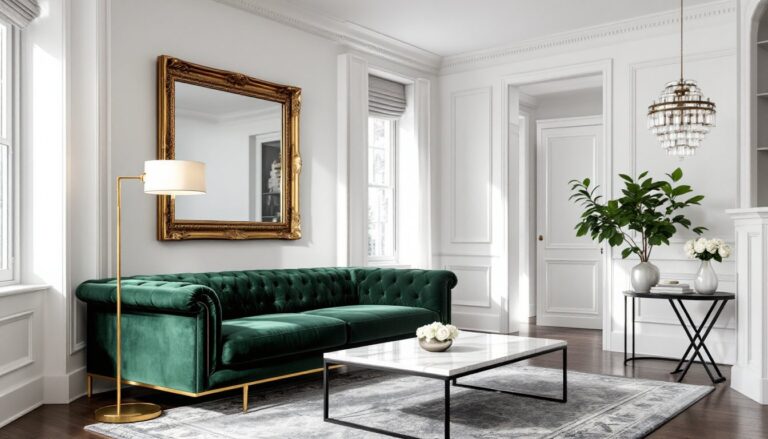
The key is scale and proportion. An ornate gilded mirror needs visual weight from other elements in the room, substantial curtains, a generously sized sofa, or substantial artwork. Don’t pair delicate antiques with oversized modern sectionals, or vice versa. Walk around furniture showrooms and antique markets with a tape measure and photos of your space. Measure doorways, ceiling heights, and available wall space before committing to any large piece.
Williams often discusses her design philosophy and furniture mixing in interviews, emphasizing how contrasting styles create visual interest that uniform rooms lack. This approach also supports sustainability, buying fewer, better pieces over time rather than replacing entire room setups every few years.
Layered Textures and Rich Fabrics
Williams builds rooms through textile layering: velvet pillows on linen sofas, silk curtains over woven wood blinds, wool rugs over sisal underlayment. This creates visual and tactile richness that paint alone can’t achieve.
For homeowners, the practical application means budgeting for textiles as seriously as furniture. A basic sofa becomes exceptional with the right pillows, mix solid velvets (about 18-inch square pillow forms work well for standard sofas) with patterned linen or cotton in complementary colors. Don’t match fabrics exactly: vary the textures while keeping colors in the same tonal family.
Curtains make an enormous difference in achieving this look. Williams favors floor-length panels in natural fabrics, mounted on substantial rods positioned 4-6 inches above the window frame and extending 8-12 inches beyond each side of the window. This makes windows appear larger and ceilings higher, a trick that works in any home, not just high-end projects.
When selecting fabrics, consider durability ratings. For high-traffic upholstery, look for fabrics rated for 15,000+ double rubs (the Wyzenbeek abrasion test standard). Linen-cotton blends hold up better than pure linen in family spaces. Wool rugs handle traffic and cleaning better than silk or viscose, though they cost more upfront.
Layering also applies to window treatments. Instead of plantation shutters alone, add curtains. Instead of bare floors, layer a smaller patterned rug over a larger sisal or jute base. These details add the depth that distinguishes professionally designed rooms from furniture showrooms.
How to Incorporate Bunny Williams’ Design Principles in Your Home
Translating Williams’ aesthetic into DIY-friendly projects requires focusing on foundational elements rather than expensive antiques or custom upholstery. Start with architectural details and paint.
If your home has flat, builder-grade doors, consider replacing them with five-panel or raised-panel doors, these cost $150-$300 per door for solid-core options and instantly elevate a home’s character. Interior door casings can be upgraded from basic ranch-style (2.5 inches wide) to more substantial colonial or craftsman profiles (3.5-4.5 inches wide). This requires a miter saw for clean 45-degree corner cuts, wood glue, a nail gun (18-gauge brad nailer works well), and painter’s caulk to fill gaps.
Crown molding makes rooms feel finished and taller. For standard 8-foot ceilings, 3.5-inch crown molding works well: for 9-foot ceilings, go up to 4.5-5.25 inches. Installation requires measuring wall angles (most corners aren’t exactly 90 degrees), cutting compound miters, and securing molding to both wall studs and ceiling joists. Use a stud finder to locate framing, and mark locations lightly with pencil before nailing.
Paint choices matter enormously. Williams gravitates toward warm neutrals, creamy whites with yellow or pink undertones rather than stark whites or cool grays. Benjamin Moore’s “White Dove” or “Linen White” appear frequently in her Connecticut home, which showcases this principle across multiple rooms. Test paint samples on at least two walls in each room, observing them at different times of day. North-facing rooms need warmer whites to counteract blue daylight: south-facing rooms can handle cooler tones.
Lighting is where many DIY projects fall short. Williams uses multiple light sources in every room, never just overhead fixtures. Budget for at least three to five light sources per room: table lamps, floor lamps, sconces, and possibly picture lights or uplights. Dimmers are essential on all overhead fixtures: install them yourself if you’re comfortable working with electrical boxes and following NEC guidelines (turn off power at the breaker, test wires with a voltage tester, match wire gauges). If not, hire a licensed electrician, improper wiring is a fire hazard.
When arranging furniture, Williams pulls pieces away from walls. Even in smaller rooms, floating a sofa 12-18 inches from the wall creates better flow and makes the space feel larger, not smaller. Anchor arrangements with properly sized rugs: for living rooms, all front furniture legs (or all four legs) should rest on the rug. An 8×10-foot rug is minimum for most living rooms: 9×12 feet works better for rooms over 200 square feet.
Bunny Williams-Inspired Color Palettes and Pattern Combinations
Williams’ color philosophy avoids stark contrasts and minimalist monochromes in favor of layered, tonal palettes. She builds rooms around three to five related colors, varying their intensity and scale rather than using high-contrast combinations.
A typical Williams palette might include: cream walls, soft sage green upholstery, camel leather accent chairs, rust-colored throw pillows, and touches of blue in artwork or ceramics. Notice these are all muted, complex colors, no primary brights or pure whites. This approach creates cohesion without being boring.
For pattern mixing, Williams follows a proven formula: vary the scale. Pair large-scale florals with small geometric prints and medium-scale stripes or checks. Keep colors consistent across patterns, if your large floral has touches of coral, echo that coral in smaller doses in your other fabrics. Don’t use more than three patterns in one room unless you have significant design experience.
Practical application: start with one patterned piece you love, a rug, curtain fabric, or upholstered chair. Pull three colors from that pattern. Use the dominant color for your largest solid pieces (sofa, walls), the secondary color for medium elements (accent chairs, throw pillows), and the tertiary color for small accents (lamp bases, artwork mats, decorative objects).
Williams often incorporates blue and white ceramics, tortoiseshell accessories, and natural wood tones. These elements appear across her design projects and serve as neutral anchors that work with changing seasonal textiles.
When painting trim and cabinetry, don’t default to bright white if your walls are warm-toned. Williams often uses the same warm white on trim as walls, or goes slightly lighter in the same color family. This creates a more sophisticated, enveloping effect than stark white trim, which can look contractor-grade rather than intentional.
For DIYers painting cabinets, proper prep determines results more than paint quality. Remove doors and hardware, clean all surfaces with TSP (trisodium phosphate) substitute, sand lightly with 220-grit sandpaper, prime with a bonding primer like Zinsser B-I-N or Cover Stain, then apply two coats of cabinet-grade paint (Benjamin Moore Advance or Sherwin-Williams ProClassic both level well). Use a high-quality brush (Purdy or Wooster) for panel details and a small foam roller for flat surfaces. Allow full cure time, at least 48 hours before rehanging, longer in humid climates.
Conclusion
Bunny Williams’ design principles offer homeowners a practical framework for creating interiors that improve with age. By prioritizing quality over trends, mixing periods thoughtfully, layering textures, and choosing warm, complex color palettes, DIYers can achieve rooms with lasting character. Start with architectural improvements and paint, invest in fewer but better furnishings, and remember that the most successful rooms serve how you actually live, not just how they photograph.