Table of Contents
ToggleGeorgian interior design has held up for nearly 300 years, not because it’s trendy, but because it’s built on principles that make a room feel balanced and right. Named after the four King Georges who ruled Britain from 1714 to 1830, this style brought order, symmetry, and classical proportions into homes. If you’ve ever walked into a space and felt it just works without knowing why, chances are you’re looking at Georgian bones. This guide breaks down what makes Georgian interiors tick and how to bring that timeless structure into your own home.
Key Takeaways
- Georgian interior design achieves timeless appeal through symmetry, classical proportions, and balanced architectural features that make spaces feel intentional and visually calm.
- Core architectural elements include high ceilings with crown molding, paneled walls, symmetrically arranged sash windows, and ornate plasterwork that reference ancient Greek and Roman design principles.
- Color palettes evolved from deep, wealth-signaling tones in Early Georgian (forest green, burgundy) to refined, lighter hues in Late Georgian (Wedgwood blue, soft gray), reflecting neoclassical taste and modern pigment accessibility.
- You can incorporate Georgian design today by adding crown molding and chair rails, painting walls in two-tone colors, centering furniture symmetrically, and choosing reproduction or antique pieces with visible craftsmanship and restrained carving.
- Avoid mixing Georgian interiors with rustic farmhouse, industrial, or minimalist elements, and prioritize quality materials like mahogany, damask upholstery, and gilt-framed mirrors that honor the style’s emphasis on proportion and durability.
- Georgian furniture and decorative traditions—from Thomas Chippendale to wingback chairs and oriental rugs—remain influential today and can be sourced through estate sales, vintage marketplaces, and period-appropriate reproduction retailers.
What Is Georgian Interior Design?
Georgian interior design refers to the architectural and decorative style that dominated British and colonial American homes from roughly 1714 to 1830. It’s a response to earlier, heavier Baroque design, Georgian stripped things down, favored symmetry, and borrowed heavily from classical Greek and Roman architecture.
The style matured over three distinct periods: Early Georgian (1714–1750) leaned ornate with rich wood paneling and heavy moldings: Mid-Georgian (1750–1765) refined proportions and introduced lighter palettes: Late Georgian (1765–1830) embraced neoclassical motifs and delicate plasterwork. What ties them together is a respect for balance, proportion, and geometry.
You’ll find Georgian influence in historic townhouses, federal-style buildings, and colonial estates. But don’t confuse it with Victorian excess or modern minimalism, Georgian sits comfortably in between, with enough ornament to feel formal but not fussy.
Key Characteristics of Georgian Style Interiors
Georgian design follows a recipe, and once you know the ingredients, you’ll spot it everywhere.
Architectural Features:
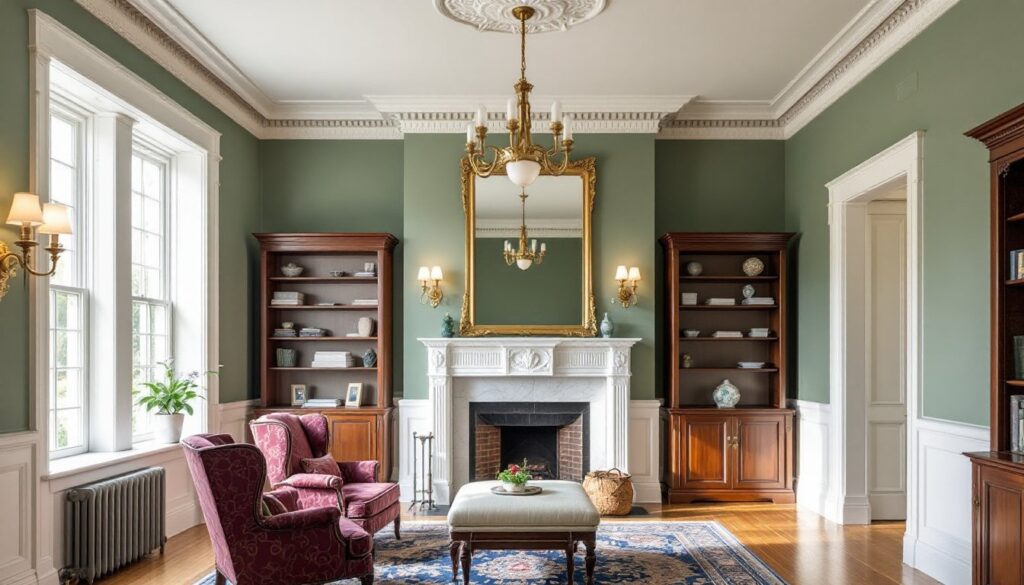
- High ceilings (typically 9 to 12 feet) with decorative crown molding and cornice work
- Paneled walls using raised or recessed panels, often painted or stained
- Sash windows (double-hung) arranged symmetrically, often in pairs or multiples of two
- Fireplaces as focal points, flanked by built-in bookcases or niches
- Classical columns and pilasters, even indoors, referencing Greek and Roman orders (Doric, Ionic, Corinthian)
- Ornate plasterwork on ceilings, think medallions, dentil molding, and egg-and-dart trim
Many traditional interiors trace their formal structure back to Georgian precedents, particularly the emphasis on molding profiles and room layout.
Symmetry and Proportion
Symmetry isn’t optional in Georgian design, it’s the whole point. Walk into a Georgian room and you’ll find matched pairs: two windows flanking a centered fireplace, two chairs bracketing a sideboard, two sconces on either side of a mirror.
Proportions follow classical ratios. Room dimensions, window heights, and even furniture scale reference Palladian principles, rules borrowed from 16th-century Italian architect Andrea Palladio, who himself studied ancient Roman buildings. Doorways align with window centers. Ceiling heights relate mathematically to room width.
This isn’t about being rigid, it’s about creating visual calm. When elements are balanced, your eye doesn’t hunt for a place to rest. If you’re planning a new home interior with Georgian influence, start by centering your largest architectural feature (fireplace, window, or doorway) and build symmetrically outward.
Color Palettes and Wall Treatments
Georgian color schemes evolved over the century, but certain hues dominated.
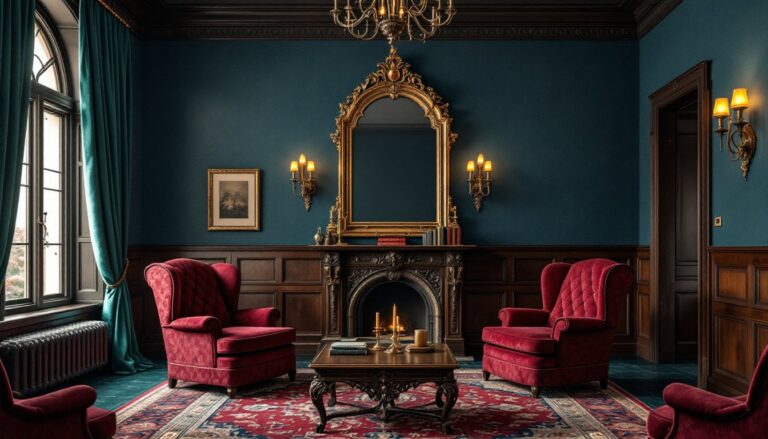
Early Georgian favored deep, saturated tones: forest green, burgundy, deep blue, and chocolate brown. These were expensive pigments at the time, so using them signaled wealth. Walls were often paneled in dark wood or painted in these rich colors.
Mid to Late Georgian shifted toward lighter, more refined palettes: soft grays, sage green, pale blue, off-white, and dusty rose. This change reflected neoclassical taste and better access to refined pigments. Wedgwood blue, a grayish-blue named after the pottery company, became iconic.
Wall treatments include:
- Raised or flat wood paneling (wainscoting) extending halfway or full-height
- Picture rails and chair rails dividing the wall into horizontal sections
- Decorative plasterwork or simple painted finishes above the chair rail
- Wallpaper (hand-blocked or painted) in damask, floral, or geometric patterns
Paint tip: Georgian homes used oil-based paints with a slight sheen, modern equivalents are eggshell or satin finishes. Flat latex won’t give you the same depth. If you’re painting paneling, sand lightly between coats and use a quality trim paint rated for durability.
Considering a refresh? Explore broader home decor interior strategies that blend historical palettes with modern applications.
Georgian Furniture and Decorative Elements
Georgian furniture is all about craftsmanship and proportion. The style matured alongside cabinetmakers like Thomas Chippendale, George Hepplewhite, and Thomas Sheraton, whose designs are still reproduced today.
Common Georgian Furniture Pieces:
- Wing chairs with high backs and rolled arms
- Settees and sofas with exposed wood frames and upholstered seats
- Cabriole-leg tables (curved legs ending in a pad or ball-and-claw foot)
- Highboys and lowboys (tall and short chests of drawers)
- Secretary desks with fold-down writing surfaces
- Four-poster beds with canopies or simple posts
Wood choices included mahogany, walnut, cherry, and oak. Mahogany, imported from the Caribbean, became the prestige material by mid-century.
Upholstery Fabrics:
- Damask (woven patterns, often floral)
- Velvet and brocade for formal spaces
- Linen and cotton in lighter colors for day rooms
- Leather for libraries and studies
Decorative Elements:
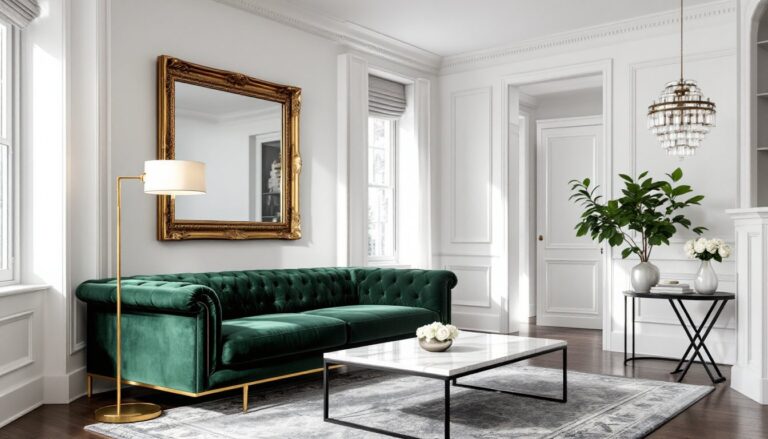
- Mirrors with gilt frames, often hung above mantels
- Chandeliers (crystal or brass) centered in formal rooms
- Porcelain vases and figurines (Chinese export porcelain was prized)
- Oil paintings in heavy frames, hung salon-style or centered above furniture
- Oriental rugs layered over wood floors
If you’re sourcing furniture, look for pieces with straight or gently curved lines, visible joinery (dovetails, mortise-and-tenon), and restrained carving. Avoid anything overly ornate or asymmetrical, that’s Victorian territory.
How to Incorporate Georgian Design in Your Home Today
You don’t need a historic mansion to bring Georgian principles into your space. Start with structure, then layer in details.
Architectural Upgrades (DIY-Friendly):
-
Add crown molding and chair rails. These are stock items at any lumberyard. Install chair rails 32–36 inches from the floor using a level, stud finder, and finish nailer (or adhesive and finishing nails if you’re patient). Crown molding requires a miter saw for clean angle cuts, 45-degree corners are standard, but measure twice.
-
Paint walls in two tones. Use a darker color below the chair rail, lighter above. This mimics paneled Georgian rooms without the carpentry.
-
Install picture rails. These sit about 12 inches below the ceiling and let you hang artwork without nailing into walls, historically accurate and renter-friendly.
-
Upgrade your doors and hardware. Replace hollow-core doors with six-panel doors (a Georgian hallmark). Swap modern knobs for brass or bronze lever handles and backplates.
-
Center your furniture and fixtures. Measure your room and mark the center point of each wall. Arrange furniture symmetrically from there.
Color and Finish Choices:
- Opt for muted, historical paint colors, brands like Farrow & Ball and Benjamin Moore offer Georgian-inspired palettes
- Use wood stains that show grain (avoid heavy polyurethane gloss: go satin)
- Choose eggshell or satin finishes for walls, semi-gloss for trim
Furniture and Decor:
- Look for reproduction Georgian furniture or antique pieces at estate sales
- Mix in modern comfort, upholstered seating in Georgian silhouettes with contemporary foam cushions
- Layer patterned rugs over hardwood or engineered wood floors (skip wall-to-wall carpet)
- Hang gilt-framed mirrors opposite windows to bounce light
For more ways to blend styles, check out ideas on home decor and interior approaches that honor the past while staying livable.
What NOT to Do:
- Don’t mix Georgian with rustic farmhouse or industrial elements, the aesthetics clash
- Avoid open-concept layouts if you’re going full Georgian: the style favors distinct, symmetrical rooms
- Skip modern minimalist fixtures: brass, bronze, or aged metals fit better than brushed nickel or chrome
Sourcing Materials:
- Molding and trim: Home Depot and Lowe’s stock basic profiles: for custom profiles, check local millwork shops
- Paint: Sherwin-Williams and Benjamin Moore have historical color collections
- Hardware: Rejuvenation, House of Antique Hardware, and Restoration Hardware offer period-appropriate pieces
- Furniture: Etsy, Chairish, and 1stDibs for vintage: Wayfair and Pottery Barn for reproductions
Resources like Decoist and Freshome showcase modern adaptations of classic design principles that can guide your material and color selections.
Conclusion
Georgian interior design isn’t about recreating a museum, it’s about borrowing structure, balance, and proportion from a style that’s proven itself over centuries. Whether you’re adding molding to a single room or planning a full renovation, the principles hold up: symmetry calms the eye, quality materials age well, and thoughtful details make a space feel intentional. Start small, measure carefully, and let the architecture do the talking.