Table of Contents
ToggleStairs do more than connect floors, they anchor a home’s visual flow, influence traffic patterns, and often set the tone for an entire interior. A poorly designed staircase eats up square footage and creates awkward sightlines. A thoughtful one becomes a centerpiece that blends form, function, and safety. Whether you’re planning a full remodel or tweaking an existing structure, understanding the interplay of style, materials, code requirements, and spatial constraints will help you make decisions that last decades.
Key Takeaways
- Interior stairs design significantly impacts both spatial efficiency and home safety, with code-compliant dimensions critical to preventing falls—riser height must stay between 4 and 7¾ inches with maximum ⅜-inch variation between risers.
- Floating stairs offer a minimalist, sculptural aesthetic that maximizes light flow but require structural reinforcement with load-bearing walls at least 6 inches thick and careful attention to baluster spacing requirements.
- Material selection for treads—from red oak ($8–$12 per board foot) to hard maple and exotic species—directly affects durability and maintenance, with hardwood selection influenced by traffic levels and climate conditions.
- Space-saving solutions like winder and spiral stairs can reduce footprint by 3–4 feet, though they require precise carpentry and may have code restrictions depending on jurisdiction and intended use.
- Tread lighting with warm LED strips (2700K–3000K) and proper handrail design serve dual purposes as safety features and aesthetic enhancements that reduce fall risk in low-light conditions.
- Finishing existing staircases by removing carpet and refinishing solid hardwood treads offers a high-end appearance at a fraction of replacement costs when treads are structurally sound.
Why Interior Stairs Design Matters More Than You Think
Staircases occupy a surprising amount of real estate, typically 80 to 100 square feet for a standard straight run, not counting landings. That footprint affects furniture placement, natural light distribution, and even HVAC efficiency. A staircase that blocks a window or forces awkward hallway turns can make a 2,000-square-foot home feel cramped.
Beyond space, stairs are a life-safety component governed by the International Residential Code (IRC). Tread depth, riser height, handrail placement, and headroom clearance aren’t suggestions, they’re minimum standards enforced during inspections. Riser height must stay between 4 and 7¾ inches, with a maximum variation of ⅜ inch between any two risers in a flight. Treads need at least 10 inches of depth. Handrails must run continuously at 34 to 38 inches above the nosing.
Ignoring these rules doesn’t just risk a failed inspection. Inconsistent riser heights are a leading cause of stair falls, especially for older adults and kids. If you’re altering an existing staircase, swapping treads, relocating a wall, or removing a handrail, check local amendments to the IRC. Some jurisdictions grandfather older stairs, but any modification can trigger a requirement to bring the entire assembly up to current code.
Aesthetically, stairs are one of the first things guests see. A well-executed design that incorporates thoughtful home decor and interior choices signals care and craftsmanship throughout the rest of the house.
Popular Interior Staircase Styles for Modern Homes
Floating Stairs: The Minimalist Statement Piece
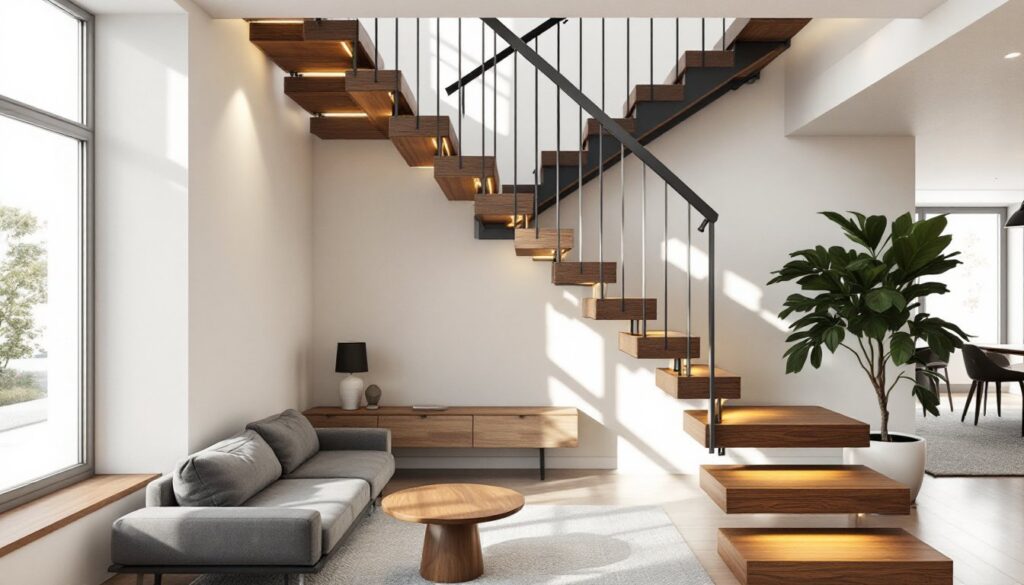
Floating stairs, also called cantilevered or open-riser stairs, fasten treads directly to a structural wall or central stringer, leaving the opposite side unsupported. The result is an airy, sculptural look that maximizes light flow and sightlines.
Structurally, each tread acts as a cantilever beam. You’ll need a load-bearing wall at least 6 inches thick (typically framed with 2×6 studs or masonry) to handle the bending moment. Treads are often 1½ to 2 inches thick hardwood, steel plate, or reinforced glass, bolted through the wall into blocking or a hidden steel channel. Some systems use a central mono-stringer, a single steel beam that supports treads from below.
Code compliance gets tricky. Many jurisdictions require 4-inch sphere guards, balusters or panels that prevent a 4-inch ball from passing through. Open risers can feel precarious to some users, and small children or pets may balk at the gaps. If you’re retrofitting a floating stair into an existing home, expect to open walls, add blocking between studs, and possibly sister joists to handle the point loads. This isn’t a DIY-friendly project unless you have structural engineering experience.
Floating stairs shine in open-concept layouts where the staircase becomes a sculptural element rather than a divider. Pair them with LED tread lighting or a statement handrail in blackened steel or wood.
Traditional Staircases with Contemporary Twists
Traditional staircases, closed risers, full skirt boards, newel posts, and turned balusters, remain the workhorse of residential construction. They’re code-friendly, budget-conscious, and easy to source. But “traditional” doesn’t mean dated.
Swap turned oak balusters for square metal spindles (½-inch steel rod or flat bar stock) powder-coated in matte black. Replace a bulky wooden handrail with a 2-inch round steel pipe or a sleek hardwood cap in walnut or white oak. Paint risers in a contrasting color, charcoal risers with natural oak treads create depth without the cost of exotic materials.
If your existing staircase has carpet, pulling it up often reveals solid 1×12 pine or fir treads beneath. Sand them smooth, apply a water-based polyurethane (three coats, 220-grit sanding between coats), and you’ve got a high-end look for the cost of finish and elbow grease. Be aware that older homes may have treads with knots, gaps, or uneven wear, plan to replace any tread that’s cracked or has more than ¼ inch of deflection under load.
Consider incorporating elements inspired by internal architecture principles to ensure your staircase integrates seamlessly with the home’s structural and aesthetic framework.
Choosing the Right Materials for Your Staircase
Tread material drives both cost and durability. Red oak is the industry standard, readily available, takes stain well, and costs $8 to $12 per board foot. White oak is harder (Janka rating of 1,360 vs. 1,290 for red oak) and has a tighter grain, but expect to pay 20 to 30% more.
For high-traffic homes, consider hard maple (Janka 1,450) or hickory (Janka 1,820). Both resist denting better than oak and hold up to kids, dogs, and dropped tools. Exotic species like Brazilian cherry or cumaru offer even greater hardness, but they’re pricier and may require special tooling (carbide-tipped saw blades) due to density.
Engineered hardwood treads use a hardwood veneer over a plywood core. They resist seasonal movement better than solid wood, crucial in homes without central humidification, and often come pre-finished. Look for a ⅛-inch wear layer: anything thinner won’t survive a single refinishing.
Metal treads (steel plate or aluminum tread plate) suit industrial or modern aesthetics. They’re durable and low-maintenance but can be slippery when wet and noisy underfoot. Apply non-slip adhesive strips or specify perforated or diamond-plate surfaces for traction.
For risers, ½-inch plywood painted white is cost-effective and code-compliant. If you want a monolithic look, use the same hardwood as the treads, or go with ¾-inch MDF primed and painted. MDF machines cleanly and won’t show wood grain through paint, but it’s heavy and doesn’t tolerate moisture.
Handrails see constant contact. Choose a wood species that’s smooth and splinter-free, poplar, maple, or red oak are all good options. Metal handrails (steel pipe, stainless tube, or powder-coated aluminum) are durable and suit contemporary designs. IRC requires handrails to have a graspable profile, between 1¼ and 2 inches in cross-sectional dimension, so avoid oversized square tubing or flat-bar stock that’s hard to grip.
Design platforms like those found on home decor inspiration sites often showcase creative material pairings that balance aesthetics and practicality.
Space-Saving Stair Design Solutions for Smaller Homes
Winder stairs replace a landing with pie-shaped treads that turn 90 or 180 degrees. They save 3 to 4 feet of linear run compared to a standard L-shaped staircase with a landing. Code requires the narrow end of each winder tread to measure at least 6 inches at a point 12 inches from the narrow edge, and the wide end can’t exceed the standard tread depth by more than a few inches.
Winders are tricky to frame and finish. Each tread is a trapezoid, so you’ll need to scribe cuts carefully. Handrail transitions get complex, curved rail sections or gooseneck fittings are often required. Unless you’re comfortable with precision carpentry, this is a job for a finish carpenter or stair specialist.
Spiral stairs occupy the smallest footprint, most residential models fit in a 5-foot-diameter circle. They’re legal as primary stairs in some jurisdictions (check local amendments), but many codes restrict them to secondary access only. Tread width at the walking line (12 inches from the narrow end) must be at least 7½ inches. Headroom clearance is measured vertically from each tread to the tread directly above, which can be tight in homes with standard 8-foot ceilings.
Prefab spiral stair kits (steel, aluminum, or wood) start around $1,500 and go up from there depending on diameter and finish. Installation is straightforward, anchor the center pole, stack and bolt treads, attach handrail sections, but getting the kit into the house and maneuvering it into position usually requires two people.
Alternating tread stairs (also called paddle stairs or ship’s ladders) have treads that alternate from left to right, allowing a steeper pitch, typically 56 to 68 degrees vs. the standard 30 to 35 degrees. They’re space-efficient but feel awkward to most users and are generally restricted to attic or loft access, not primary living areas. Some codes prohibit them entirely for habitable spaces.
If you’re working within tight quarters, tools for visualizing spatial layouts, such as home interior design software, can help you test configurations before committing to a build.
Lighting and Safety Features That Enhance Stair Design
Tread lighting isn’t just aesthetic, it’s a fall-prevention measure. LED strip lights recessed into risers or mounted under tread nosings provide uniform, glare-free illumination. Look for 12V DC strips rated at 2700K to 3000K (warm white) and at least 200 lumens per foot. Wire them to a motion sensor or photocell so they activate automatically at dusk or when someone approaches.
Installing tread lights in an existing staircase requires routing a shallow channel in each riser (a router with a ¼-inch straight bit works well), running low-voltage wire through the stringer, and connecting to a transformer. If you’re not comfortable with basic electrical work, hire a licensed electrician. Even low-voltage systems can create fire hazards if connections are loose or wire gauge is undersized.
Handrail lighting integrates LEDs into the rail itself, casting light downward onto treads. Some systems use a translucent rail with internal LEDs: others mount a strip along the underside of a wood or metal rail. Kits are available, but custom installations often deliver better results.
Wall sconces or pendant lights over a landing add ambient light and visual interest. Mount sconces at 60 to 66 inches above the tread nosing to avoid head strikes. If you’re hanging a pendant, ensure at least 6½ feet of clearance below the fixture.
Safety upgrades go beyond code minimums. Add a second handrail on the opposite wall if the staircase is wider than 44 inches, it’s not required, but it helps users with mobility issues. Install non-slip tread nosing, metal or rubber profiles that increase friction, on the leading edge of each tread. They’re especially useful on painted or sealed wood, which can be slick.
Baluster spacing is critical. IRC caps spacing at 4 inches on-center for residential stairs (the 4-inch sphere rule again). If you’re replacing balusters, measure and mark drilling points carefully. Drilling into a handrail at inconsistent spacing looks sloppy and weakens the structure.
For homes with young children or elderly residents, consider a contrasting nosing strip, a different color or material on the tread edge, to improve depth perception. Falls often occur because users misjudge the edge of a tread, especially in low light. Platforms like Decoist regularly feature lighting solutions that balance safety with modern design.
Finally, ensure adequate headroom clearance, at least 6 feet 8 inches measured vertically from each tread nosing to any ceiling, beam, or obstruction above. If you’re finishing a basement or attic staircase, don’t assume the framing gives you enough room. Measure before you drywall.
Whether you’re drawn to the clean lines seen in smart home design or the character of reclaimed materials showcased on Freshome, lighting and safety features should never be afterthoughts, they’re foundational to a staircase that performs as well as it looks.